
Online Reviews: Separating Genuine Feedback from Manufactured Praise

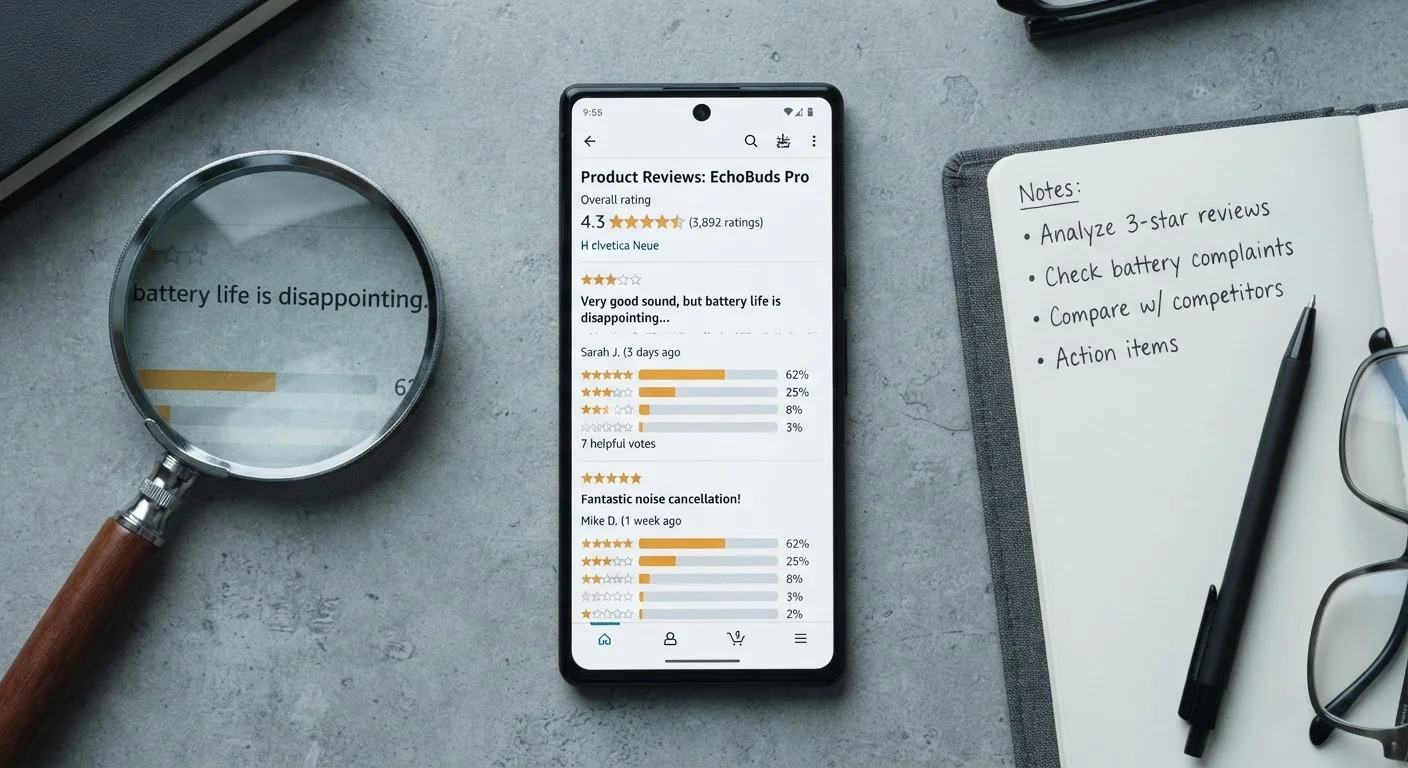
Photo: AskSpecialist.net editorial
Key Takeaways
- A high average star rating alone is not a reliable indicator of product quality or honest feedback.
- Incentivized and fake reviews are widespread across major retail platforms, including well-known marketplaces.
- Review volume, date patterns, language specificity, and reviewer history all signal credibility.
- Cross-referencing multiple independent sources is more reliable than trusting any single review platform.
- Negative reviews, when specific and consistent, often contain the most actionable buying information.
Why Review Credibility Is Harder to Assess Than It Looks
Online reviews have become one of the primary ways American consumers evaluate products before buying - and that influence has made the review ecosystem a target for manipulation. Understanding the common myths around review credibility isn't just academic: acting on manufactured praise is one of the most consistent sources of post-purchase regret reported by shoppers.
The good news is that reviews still contain genuinely useful information. The skill lies in knowing which signals to weight and which to discount. For a broader approach to evaluating products before you commit, see Product Evaluation From Scratch.
Myth
A product with a 4.8-star average and hundreds of reviews is almost certainly high quality.
Fact
High ratings and large review counts can both be artificially inflated through incentivized or coordinated review schemes.
Review volume and high averages create a powerful impression of social proof, but neither metric is immune to manipulation. Research from consumer advocacy groups and academic studies has consistently found that platforms hosting millions of reviews struggle to detect coordinated campaigns where sellers offer refunds, gift cards, or free replacements in exchange for five-star ratings.
A more useful approach: sort by lowest-rated reviews and read those first. Specific, consistent complaints about the same issue - battery life, fit, durability - carry far more signal than a wall of generic praise. Also check whether the rating distribution has an unusual "J-curve" (mostly 5s and 1s with very few in between), which can indicate manipulation.
Myth
Verified purchase badges mean a review is honest and unbiased.
Fact
"Verified purchase" only confirms a transaction occurred - it does not rule out incentivized or coached feedback.
Platforms use verified purchase labels to distinguish buyers from non-buyers, which does filter out some entirely fake accounts. However, it does not address the more common problem: real buyers who received a product for free, at a steep discount, or under the condition of leaving feedback. These transactions are real purchases - they just come with strings attached.
The Federal Trade Commission (FTC) requires that material connections between reviewers and sellers be disclosed, but enforcement at the individual review level is uneven. Treat verified badges as a modest quality signal, not a guarantee of independence.
Myth
Negative reviews are usually from difficult customers who can't be satisfied.
Fact
Specific, detail-rich negative reviews are often among the most accurate and useful feedback available.
There's a cultural tendency to dismiss critical reviews as outliers or over-reactions. In practice, a negative review that describes a precise failure - "the zipper broke after six uses" or "the motor overheats after 20 minutes" - reflects exactly the kind of real-world durability information that marketing copy never provides.
Pay particular attention when multiple unconnected reviewers report the same specific problem. One complaint may be an anomaly; five complaints describing identical symptoms is a pattern worth taking seriously. For context on evaluating these signals holistically, see Reading Between the Lines of Online Product Reviews.
Myth
Third-party review aggregators and independent sites are always more trustworthy than retailer reviews.
Fact
Independent review sites vary widely in methodology, funding, and conflict-of-interest management - none should be accepted uncritically.
Editorial review sites and consumer testing organizations range from rigorous and transparent to essentially undisclosed affiliate operations. The presence of a professional-looking website or a domain with "reviews" in the name does not guarantee independence. Look for sites that explain their testing methodology, disclose how products are sourced, and are transparent about revenue models.
Organizations that purchase products anonymously and publish structured test results under clear methodology statements tend to be more reliable than sites whose income depends on commission from the products they evaluate. When in doubt, triangulate: if multiple independent sources reach similar conclusions, that convergence is meaningful. Our Product Evaluation hub outlines a framework for doing exactly that.
Myth
Responding to reviews is just PR - it doesn't tell you anything useful about the seller.
Fact
How a seller responds to critical reviews reveals a great deal about their customer service values and accountability.
Seller responses to negative reviews are one of the more underused pieces of information available to shoppers. A response that acknowledges a specific problem and offers a resolution path signals a seller who stands behind their product. Responses that deflect, blame the customer, or paste generic text signal the opposite.
Also watch for patterns: does the seller flag and remove critical reviews over time? Does the product have a history of relaunching under a slightly different name or listing? These behaviors, while difficult to detect, are worth investigating for higher-stakes purchases.
Practical Habits That Improve How You Use Reviews
Correcting your assumptions about reviews is only useful if it changes your actual research behavior. A few consistent habits make a meaningful difference:
- Sort by recency and read the 2- and 3-star reviews first. Middle-range reviews are the hardest to fake and often contain the most honest trade-off assessments.
- Check reviewer profiles. An account with 50 reviews posted in one week, all five stars for unrelated product categories, is a strong indicator of a review farm or incentivized campaign.
- Search for the product name plus "problems" or "issues" in a general web search. This surfaces forum discussions, Reddit threads, and independent commentary that review platforms don't index.
- Look for consistency across platforms. If a product scores well on one retailer but poorly on another where it's sold by a different seller, the disparity is worth investigating.
Sudden Rating Surges Are a Red Flag
Building a repeatable research habit around these signals - rather than defaulting to star averages - aligns with the broader framework described in Finding Value Without Falling for Hype. The same principles that protect you from marketing manipulation apply directly to review manipulation.
Reviews Are One Signal, Not the Decision
This article provides general consumer information and education. It is not legal or financial advice. For guidance specific to your situation, consult a qualified professional.
The content on this site is provided for informational purposes only and should not be considered a substitute for professional advice. While we strive to provide accurate and up-to-date information, we make no guarantees regarding its completeness or accuracy. Always consult a qualified professional for advice specific to your circumstances before making any decisions.