
Why "Limited Time" Rarely Means What It Says

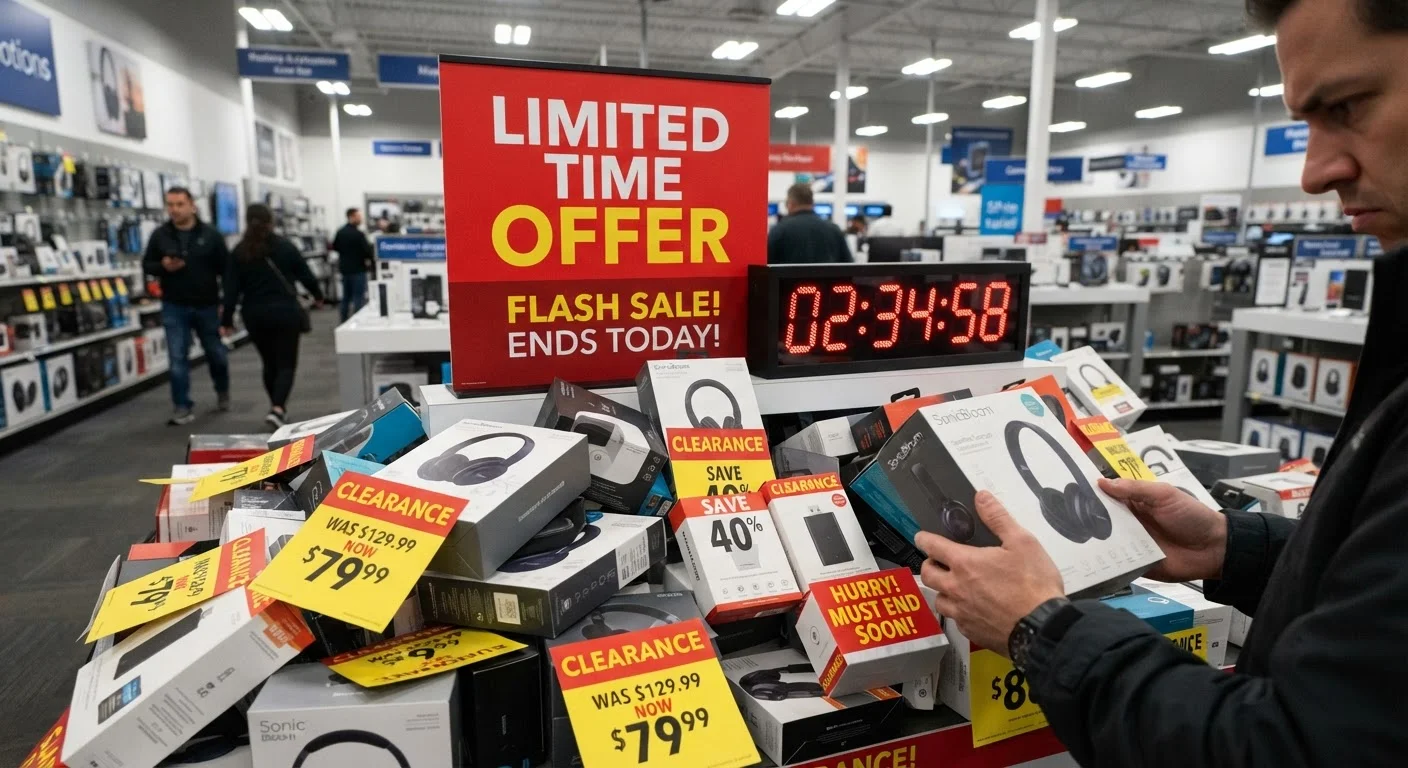
Photo: AskSpecialist.net editorial
Key Takeaways
- "Limited time" labels are a marketing convention, not a legal guarantee of true scarcity.
- Many countdown timers and low-stock alerts are scripted to reset automatically or display by default.
- Price history tools give consumers an objective baseline to evaluate whether a "deal" is real.
- Genuine markdowns follow predictable seasonal cycles that don't require artificial pressure.
- Slowing down a purchase decision rarely results in missing a legitimately good price.
How Urgency Becomes a Sales Tool
Urgency is one of the oldest levers in retail. The logic is straightforward: when consumers believe they may miss out, they decide faster and scrutinize less. What has changed is the sophistication of the delivery mechanism. Digital retail environments allow urgency cues - countdown timers, low-stock badges, flash-sale banners - to be deployed at scale, personalized, and A/B tested for maximum conversion impact.
None of this makes urgency inherently deceptive. Genuine clearance events, end-of-season markdowns, and limited production runs do exist. The problem is that the same visual and verbal language is used for both real and manufactured scarcity, giving consumers no reliable surface-level signal to distinguish them.
Urgency Is Designed to Bypass Deliberation
The practical implication is simple: the sensation of urgency is not evidence of a deal. It is evidence that a conversion optimization team is doing its job.
The Myths Urgency Marketing Relies On
Urgency tactics work because they reinforce a set of beliefs that most shoppers carry as background assumptions. Examining those beliefs directly - and correcting them with what the evidence actually shows - is the most reliable inoculation against manufactured pressure.
Myth
If the timer runs out, the deal disappears forever.
Fact
Most countdown timers on retail and e-commerce sites reset automatically or are set by default on product pages regardless of actual inventory status.
Countdown timers are one of the most studied urgency tactics in e-commerce design. In many cases, these timers are template elements that restart on page reload or after the clock reaches zero. They signal urgency without being tied to any real inventory threshold or promotion end date. Before acting on a timer, try refreshing the page or returning the next day - the "deal" is frequently still available. For a deeper look at how these mechanics work, see how countdown timers and low-stock alerts actually function.
Myth
A "limited time" sale means the price is genuinely lower than normal.
Fact
Without a verifiable price history, there is no way to confirm a "sale" price represents a real discount from a stable baseline.
Retailers are generally permitted to set their own reference prices, and promotional framing like "limited time" carries no standardized legal definition in most U.S. retail contexts. A price labeled as 30% off may have only briefly appeared at the higher price - or never been offered at that price in meaningful volume. Free browser extensions that track historical pricing on major platforms give consumers an objective benchmark. If the "sale" price matches or exceeds the item's 90-day average, the urgency framing deserves serious skepticism. Our guide to spotting inflated discounts and misleading offers covers additional red flags.
Myth
Low-stock alerts mean an item is genuinely about to sell out.
Fact
"Only 3 left" messages can be triggered by inventory thresholds set by retailers and may not reflect total available supply across warehouses or channels.
Inventory display logic on retail platforms is controlled by the seller. A "low stock" label may activate when a product drops below a preset threshold - say, 10 units - even if thousands more are warehoused or available through other fulfillment channels. Some third-party marketplace sellers set these alerts manually as a conversion tool. If an item is widely distributed, stock is unlikely to be a genuine constraint. Checking the product across multiple retailers is usually sufficient to dispel the urgency.
Myth
Flash sales offer the lowest prices of the year.
Fact
Many product categories follow predictable markdown calendars, and the lowest prices often occur at well-documented seasonal windows - not during promotional flash events.
Electronics, appliances, bedding, and apparel, among other categories, each tend to hit their lowest prices at identifiable points in the retail calendar - model-year changeovers, post-holiday clearance, and end-of-season transitions. Flash sales create the impression of exceptional, time-limited value, but comparison against seasonal price history often shows these "flash" prices are matched or beaten during routine clearance periods. Understanding when prices on common categories actually drop removes the guesswork entirely.
Myth
Retailers are required to be truthful about sale durations and stock levels.
Fact
Federal and state consumer protection rules address deceptive pricing in broad terms, but enforcement is inconsistent and thresholds for what qualifies as deceptive vary.
The FTC's guidelines on deceptive pricing establish general principles - for instance, a "former price" used as a reference should reflect a price at which the item was actually offered for a reasonable period. However, regulatory enforcement is case-by-case, and many urgency tactics operate in ambiguous territory. Consumers cannot rely on compliance assumptions. Reading promotional terms carefully and understanding standard retail language pays dividends; our retail marketing language glossary translates the terms retailers count on shoppers not knowing.
Across each of these myths, the common thread is that urgency signals ask shoppers to accept a retailer's framing at face value rather than verify it independently. The verification tools are widely available and usually free; the barrier is knowing to use them. For further context on what hidden terms can cost you after a purchase, see what retailers bury in their terms.
Reference Prices Are Often Inflated
A Practical Response to Urgency Pressure
The most effective counter to urgency framing is a brief, deliberate pause combined with a small number of verification steps. Before committing to a purchase driven by a time or stock warning, consider the following:
- Check price history. Browser extensions and price-tracking sites provide 90-day and longer price histories for items on major platforms. If today's price is not meaningfully below the average, the urgency framing is doing the work - not the discount.
- Search competing retailers. A genuinely scarce or uniquely discounted item will typically not be widely available at the same or lower price elsewhere. If it is, scarcity is not real.
- Wait 24 hours. Return to the listing after the timer would have expired. In most cases, the price and availability will be unchanged. This exercise alone is a reliable calibration tool.
- Read the promotion terms. "Limited time" is rarely defined with a specific end date in the fine print. When it is defined, the timeframe is often longer than the urgency cue implies.
Slowing down is not the same as missing out. In a retail environment where urgency is a default design pattern, deliberation is the consumer's most effective tool.
60%+
Consumers influenced by scarcity cues
Consumer psychology research has repeatedly found that perceived scarcity significantly elevates purchase intent, often independent of actual product quality or value.
~40%
Online "sales" with inflated reference prices
Studies examining e-commerce pricing have found a substantial share of discounted listings use reference prices that the item rarely or never sold at in normal retail conditions.
The content on this site is provided for informational purposes only and should not be considered a substitute for professional advice. While we strive to provide accurate and up-to-date information, we make no guarantees regarding its completeness or accuracy. Always consult a qualified professional for advice specific to your circumstances before making any decisions.