
Bodyweight Training: What It Can and Can't Realistically Achieve

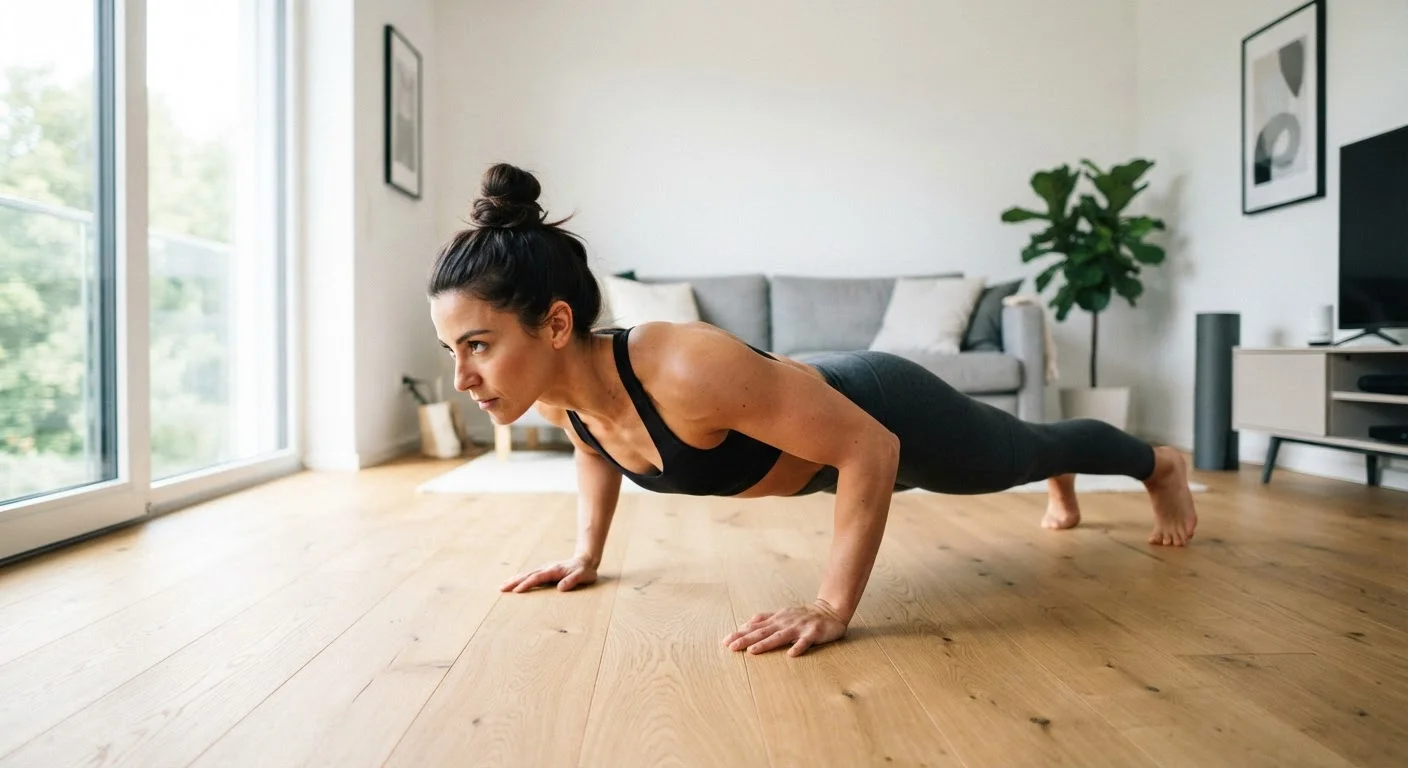
Photo: AskSpecialist.net editorial
Key Takeaways
- Bodyweight training can build real functional strength and cardiovascular fitness without any equipment.
- It has meaningful limitations for building maximum muscle mass or achieving advanced strength gains.
- Accessibility and low cost make it one of the most sustainable exercise options for everyday Americans.
- Combining bodyweight work with other training modalities typically produces better long-term results.
- Progression is still possible - but requires deliberate exercise variation and increasing difficulty over time.
Zero cost and no equipment required
Push-ups, squats, and planks need only a small amount of floor space, removing financial and logistical barriers that often derail exercise consistency.
Builds functional, real-world strength
Bodyweight movements frequently mirror everyday physical tasks - getting up from a chair, carrying groceries, climbing stairs - making strength gains directly applicable to daily life.
Effective for beginners and returning exercisers
For people new to training or rebuilding fitness, bodyweight resistance is often sufficient to trigger meaningful strength adaptation without the complexity of weighted equipment.
Can support cardiovascular conditioning
Circuit-style sequences and higher-rep bodyweight workouts elevate heart rate enough to contribute to aerobic fitness, particularly when rest periods are managed carefully.
Reduces injury risk from improper loading
Without external weights, the risk of form-related injuries from excessive load is substantially lower, which matters especially for those exercising without professional supervision.
Flexible scheduling and location
Training at home, in a park, or while traveling removes the time overhead of commuting to a gym, which research identifies as a key barrier to exercise adherence.
Limited stimulus for advanced muscle growth
Maximizing hypertrophy - muscle size - generally requires progressively heavier external loads. Bodyweight alone tends to plateau as a growth stimulus once intermediate fitness is reached.
Difficult to target certain muscle groups
Muscles like the hamstrings, upper back, and biceps are harder to load effectively without equipment, leaving some muscle groups underdeveloped relative to others.
Progression requires creative planning
Unlike adding weight plates, increasing bodyweight exercise difficulty demands knowledge of exercise progressions and technique variations that can be difficult to self-direct without guidance.
Less effective for strength sport or performance goals
Athletes training for powerlifting, Olympic lifting, or sport-specific strength need external loading that bodyweight cannot replicate, making it an inadequate primary training method for those purposes.
Some exercises require significant existing strength
Advanced bodyweight movements like pull-ups or dips may be inaccessible to beginners, limiting variety and progression options early in a fitness journey.
What Bodyweight Training Actually Is
Bodyweight training uses your own body as the primary source of resistance - no barbells, machines, or gym membership required. Exercises like push-ups, squats, lunges, planks, pull-ups, and dips form its foundation. It spans a wide range of difficulty, from beginner-friendly movements to advanced progressions like single-leg squats (pistol squats) or handstand push-ups.
Because it demands nothing more than a small amount of space, it's one of the most accessible forms of physical activity available. That accessibility is both its greatest strength and, for some fitness goals, the source of its core limitations. Understanding both sides helps you decide how - and how much - to rely on it. See also our look at home workouts vs. gym workouts for broader context on training environments.
The Real Advantages
The case for bodyweight training is grounded in exercise science, not just convenience culture.
Zero cost and no equipment required
Push-ups, squats, and planks need only a small amount of floor space, removing financial and logistical barriers that often derail exercise consistency.
Builds functional, real-world strength
Bodyweight movements frequently mirror everyday physical tasks - getting up from a chair, carrying groceries, climbing stairs - making strength gains directly applicable to daily life.
Effective for beginners and returning exercisers
For people new to training or rebuilding fitness, bodyweight resistance is often sufficient to trigger meaningful strength adaptation without the complexity of weighted equipment.
Can support cardiovascular conditioning
Circuit-style sequences and higher-rep bodyweight workouts elevate heart rate enough to contribute to aerobic fitness, particularly when rest periods are managed carefully.
Reduces injury risk from improper loading
Without external weights, the risk of form-related injuries from excessive load is substantially lower, which matters especially for those exercising without professional supervision.
Flexible scheduling and location
Training at home, in a park, or while traveling removes the time overhead of commuting to a gym, which research identifies as a key barrier to exercise adherence.
Research consistently shows that resistance training using bodyweight can stimulate muscle protein synthesis and improve muscular endurance, particularly in people who are new to exercise or returning after a period of inactivity. For cardiovascular conditioning, circuit-style bodyweight routines can elevate heart rate effectively - comparable in intensity to moderate aerobic exercise. This makes bodyweight training a legitimate option for meeting general physical activity guidelines, not simply a placeholder until you can access a gym.
If joint health is a concern, many bodyweight movements are inherently lower-impact than loaded alternatives. Our related article on low-impact exercise options explores this dimension further.
Where It Falls Short
Honest fitness guidance means acknowledging what bodyweight training cannot reliably deliver - especially for those with more specific goals.
Limited stimulus for advanced muscle growth
Maximizing hypertrophy - muscle size - generally requires progressively heavier external loads. Bodyweight alone tends to plateau as a growth stimulus once intermediate fitness is reached.
Difficult to target certain muscle groups
Muscles like the hamstrings, upper back, and biceps are harder to load effectively without equipment, leaving some muscle groups underdeveloped relative to others.
Progression requires creative planning
Unlike adding weight plates, increasing bodyweight exercise difficulty demands knowledge of exercise progressions and technique variations that can be difficult to self-direct without guidance.
Less effective for strength sport or performance goals
Athletes training for powerlifting, Olympic lifting, or sport-specific strength need external loading that bodyweight cannot replicate, making it an inadequate primary training method for those purposes.
Some exercises require significant existing strength
Advanced bodyweight movements like pull-ups or dips may be inaccessible to beginners, limiting variety and progression options early in a fitness journey.
Not All Goals Are Equal
For a fuller picture of how resistance training compares to other exercise types, the article strength training vs. cardio explains the distinct physiological roles each plays.
Progression: The Key Variable Most People Overlook
One underappreciated challenge with bodyweight training is the progression problem. With free weights, you add incremental load - a straightforward way to apply the principle of progressive overload, which is central to continued strength and muscle development. With bodyweight, you must engineer difficulty increases through exercise variation, leverage changes, tempo manipulation, or reduced stability.
~72%
Adults citing cost as an exercise barrier
A CDC physical activity report identified cost and access as among the most commonly reported barriers to regular exercise among American adults.
8-12 weeks
Typical timeline for beginner strength gains
Exercise physiology research generally shows that untrained individuals begin experiencing measurable strength improvements within 8-12 weeks of consistent resistance training.
This isn't impossible - it just requires more deliberate planning than many people anticipate. Moving from standard push-ups to archer push-ups, or from two-leg to single-leg squat progressions, represents genuine progression. But self-directing that path without guidance can be tricky. Resources like our article on common fitness myths can help separate useful strategies from unhelpful ones.
Those who find bodyweight ceilings limiting may benefit from introducing resistance bands, weighted vests, or transitioning toward free weights. Our guide on getting started with resistance training is a practical next step for anyone ready to make that shift.
This article is for general informational and educational purposes only and is not a substitute for professional medical or fitness advice. Consult a qualified healthcare provider or certified fitness professional before beginning any new exercise program, especially if you have an existing health condition or injury.
The content on this site is provided for informational purposes only and should not be considered a substitute for professional advice. While we strive to provide accurate and up-to-date information, we make no guarantees regarding its completeness or accuracy. Always consult a qualified professional for advice specific to your circumstances before making any decisions.