
Hardwood, Engineered Wood, and Laminate Flooring Compared

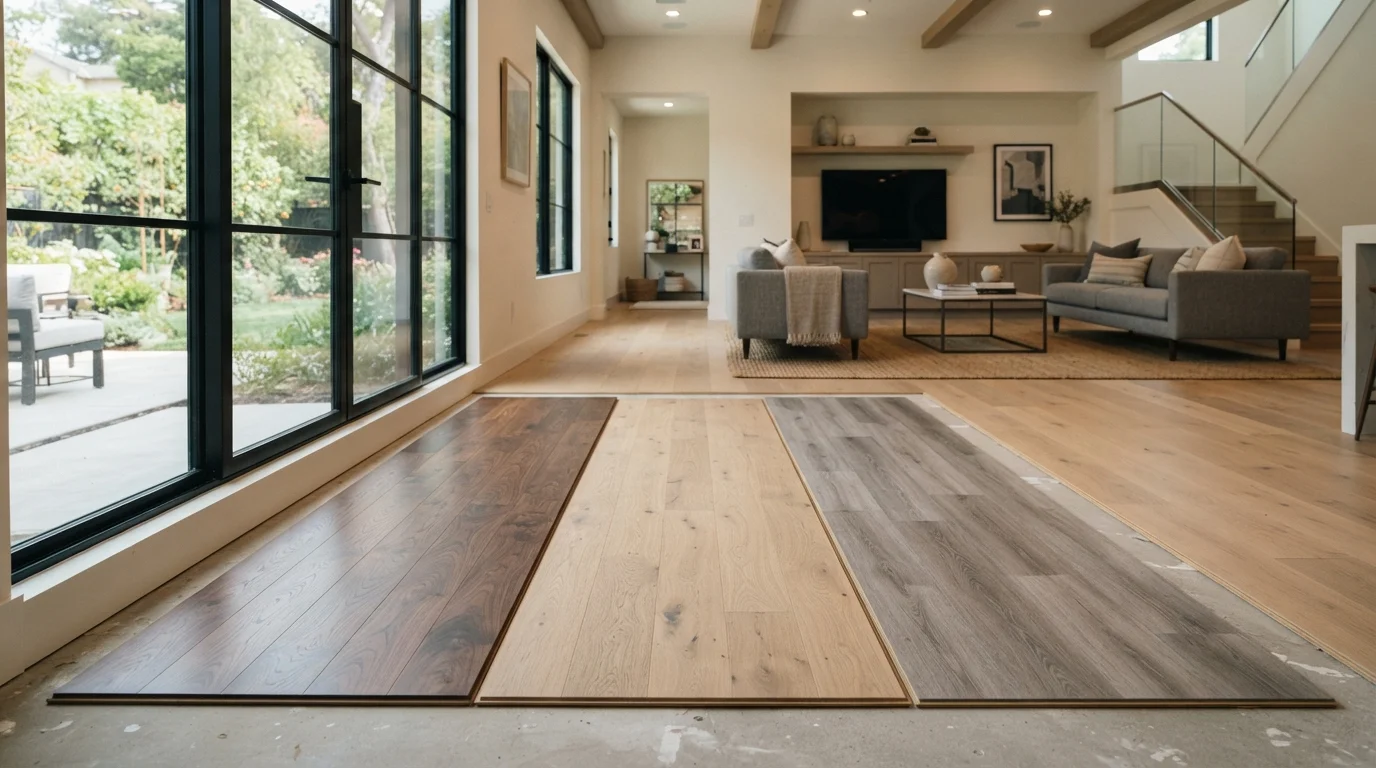
Photo: AskSpecialist.net editorial
Key Takeaways
- Solid hardwood offers the longest lifespan and can be sanded and refinished multiple times.
- Engineered wood handles moisture and temperature swings better than solid hardwood.
- Laminate is the most budget-friendly option but cannot be refinished and is vulnerable to water damage.
- Subfloor type, room location, and household traffic level should guide your flooring choice.
- All three options can be installed as DIY projects, though difficulty and method vary significantly.
What Each Flooring Type Actually Is
Understanding what you're buying matters before comparing performance. Solid hardwood is milled from a single piece of wood - typically oak, maple, or hickory - and ranges from ¾ to ⅝ inch thick. That thickness is what allows it to be sanded and refinished multiple times over decades.
Engineered wood looks nearly identical to solid hardwood on the surface because it uses a real wood veneer on top. Beneath that veneer, layers of plywood or high-density fiberboard (HDF) are cross-stacked for dimensional stability. This construction resists expansion and contraction caused by moisture and temperature changes far better than solid wood does.
Laminate contains no real wood. The visible layer is a photographic image of wood grain sealed under a tough wear layer - typically aluminum oxide. Below that sits an HDF core and a moisture-resistant backing. Modern laminate has improved dramatically and can be difficult to distinguish from wood visually, though it lacks the texture and warmth of the real thing underfoot.
Durability, Moisture, and Where Each Flooring Belongs
Room placement is one of the most practical filters you can apply. Solid hardwood is best suited to above-grade rooms - living rooms, dining rooms, and bedrooms - in homes with controlled humidity. Wood expands and contracts with moisture, and solid planks have no dimensional safeguard against that movement. In bathrooms or basements, solid hardwood is generally a poor fit.
Engineered wood expands the usable range. Its cross-ply construction tolerates moderate moisture fluctuation, making it a reasonable choice for kitchens, first-floor areas over concrete slabs, or finished basements in regions with seasonal humidity swings. It's not waterproof - standing water will still damage it - but it handles everyday moisture exposure with far more resilience.
Laminate is scratch-resistant and easy to clean, which suits homes with pets or children. However, its HDF core is particularly vulnerable to water infiltration at seams. Even with a moisture-resistant backing, prolonged exposure can cause swelling and warping. Most laminate manufacturers advise against installing it in full bathrooms or below-grade spaces unless the product is specifically rated as waterproof.
| Solid Hardwood | Engineered Wood | Laminate | |
|---|---|---|---|
| Composition | Single solid wood plank | Wood veneer over plywood/HDF core | Photographic layer over HDF core |
| Moisture Tolerance | Low - above-grade dry rooms only | Moderate - handles humidity variation | Low-moderate - vulnerable at seams |
| Refinishable | Yes - multiple times | Sometimes - once or twice | No |
| Typical Lifespan | 80-100 years | 25-30 years | 15-25 years |
| DIY Installation Difficulty | Moderate to high | Low to moderate | Low |
| Subfloor Compatibility | Wood subfloor required | Wood or concrete | Wood or concrete |
| Scratch Resistance | Moderate - varies by wood species | Moderate | High wear layer |
Installation: What DIYers Should Know
All three flooring types are DIY-accessible, though the skills required differ. Solid hardwood is traditionally nailed or stapled down to a wood subfloor using a flooring nailer - a specialized tool most homeowners rent. It must acclimate in the home for several days before installation to reduce post-install movement. This is the most involved installation process of the three.
Engineered wood can be glued, nailed, or floated (where planks click together without adhesive). The floating method is the most beginner-friendly. Acclimation is still recommended but typically shorter than with solid hardwood. Engineered products can be installed over concrete, which broadens the usable subfloor types considerably.
Laminate almost universally uses a click-lock floating system, which is among the easiest flooring installations available to DIYers. No nails, no glue, and minimal subfloor prep beyond ensuring the surface is flat and dry. If you're planning a renovation that touches room layout - see our discussion of open vs. defined floor plan trade-offs - laminate's ease of removal and reinstallation can be an advantage during future remodeling work.
Acclimate Before You Install
Long-Term Care, Refinishing, and Lifespan
Maintenance requirements differ meaningfully across all three options. Solid hardwood can be sanded down and refinished - typically three to five times over its life - allowing homeowners to refresh scratched or dull surfaces or change stain colors entirely. With proper care, solid hardwood floors can last 80 to 100 years. Routine care involves dry mopping, occasional damp cleaning with a wood-safe cleaner, and avoiding excess moisture.
Engineered wood may be refinishable once or twice depending on the veneer thickness, typically 2mm or greater. Thinner veneers cannot safely withstand sanding. Lifespan typically runs 25 to 30 years with proper care. It requires the same moisture-avoidance practices as solid wood.
Laminate cannot be refinished. Once the wear layer scratches through, replacement is the only option. That said, its wear layer is highly scratch-resistant in the first place, and individual planks can sometimes be swapped out in floating installations. Laminate generally lasts 15 to 25 years depending on traffic and care, and its maintenance is the simplest - damp mopping with a laminate-specific cleaner is typically all that's needed.
The content on this site is provided for informational purposes only and should not be considered a substitute for professional advice. While we strive to provide accurate and up-to-date information, we make no guarantees regarding its completeness or accuracy. Always consult a qualified professional for advice specific to your circumstances before making any decisions.