
Countdown Timers, Low-Stock Alerts, and Other Urgency Tactics Explained

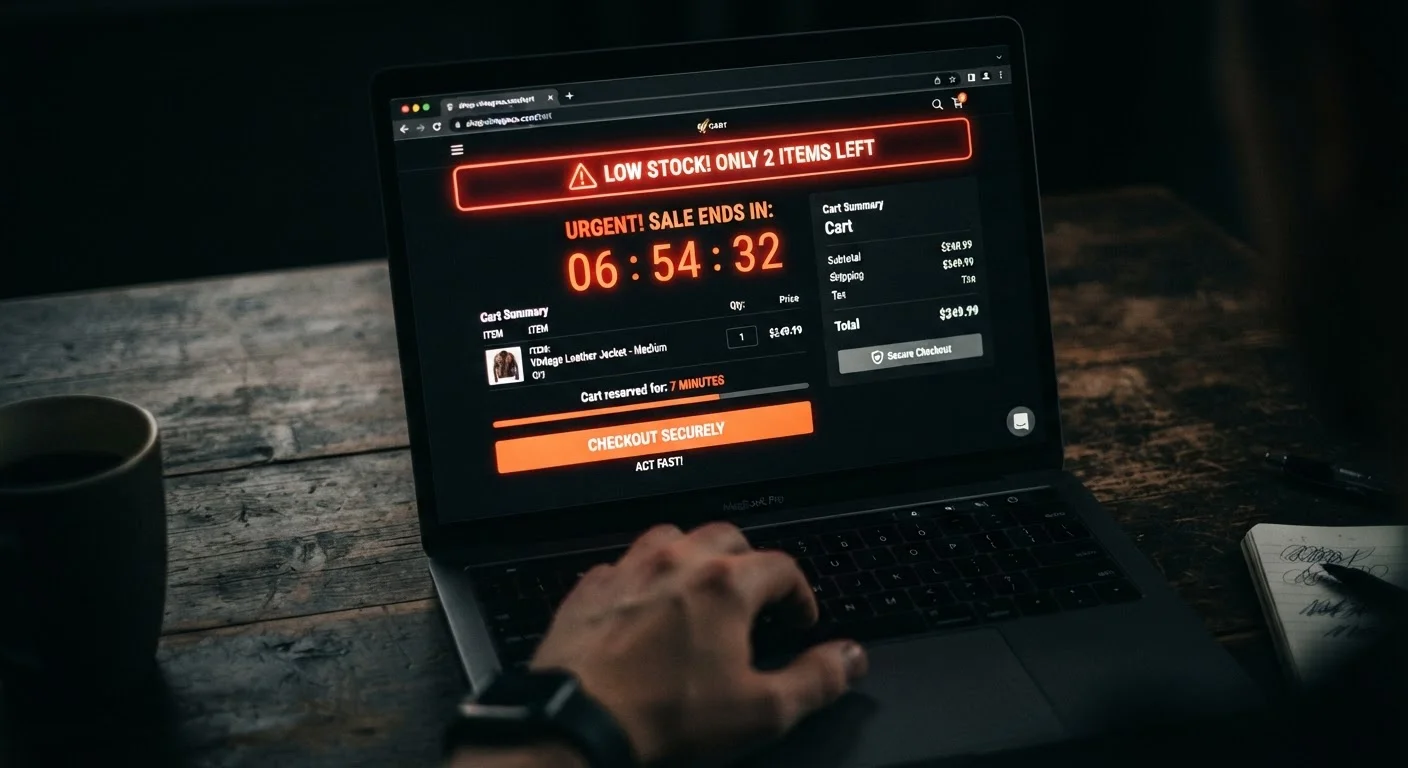
Photo: AskSpecialist.net editorial
Key Takeaways
- Countdown timers and low-stock alerts are marketing tools, not neutral information - treat them skeptically.
- Many urgency cues are automated or artificial, unconnected to actual inventory or deadline constraints.
- Pausing before purchasing is the single most effective defense against manufactured pressure.
- Genuine scarcity does exist, but it can usually be verified through simple research steps.
- Understanding how urgency tactics work helps you shop intentionally rather than reactively.
How Urgency Tactics Work on Shoppers
Urgency is one of retail marketing's oldest levers. The logic is straightforward: when people believe they might miss out, they make faster decisions and skip their usual scrutiny. Online shopping supercharged this dynamic by making real-time cues - ticking clocks, low-inventory warnings, "X people are viewing this now" alerts - trivially cheap to deploy at scale.
The result is a shopping environment saturated with pressure signals, many of which have no relationship to actual supply or time constraints. This doesn't mean every urgency cue is deceptive, but it does mean consumers who react automatically rather than deliberately are the most vulnerable to overspending. As we've covered in our look at impulse buying vs. intentional shopping, reactive purchases driven by perceived urgency often lead to buyer's remorse and budget damage.
Below are the most common urgency tactics you'll encounter, what they actually signal, and how to evaluate them without getting played.
Countdown Timers
A ticking clock on a product page or in a promotional email creates time pressure - and that's precisely its function. Many countdown timers are tied to nothing more than a script that resets when it hits zero, or one that's synced to a sale that will simply restart under a different name tomorrow.
That said, some timers do mark real cutoffs: same-day shipping deadlines based on warehouse schedules, for example, are typically genuine. The tell is specificity and consistency. A shipping cutoff timer that reflects an actual carrier pickup time is different from a "sale ends soon" clock that resets on refresh.
What to do: If the timer is attached to a shipping cutoff, it's probably real - check the carrier's schedule to confirm. If it's attached to a price or "deal," search the same product on a price-tracking tool or check whether the "sale" price has been the baseline price for weeks.
Many countdown timers reset automatically - the deadline is the script, not reality.
Low-Stock and "Only X Left" Alerts
"Only 3 left in stock" is among the most widely used urgency cues in e-commerce. Some platforms display this figure accurately; others generate it dynamically based on algorithms designed to trigger scarcity perception regardless of actual warehouse inventory. The figure shown may reflect one regional warehouse, a product variant, or a threshold set by the retailer rather than total available stock.
For genuinely limited-run items - a specific color of a product made in small quantities, for instance - low-stock alerts can carry real weight. For mass-market goods sold by major retailers, treat them as marketing by default until proven otherwise.
What to do: Search the same product on at least one other retailer's site. If it's widely available elsewhere with no scarcity signal, the alert is almost certainly artificial. If multiple independent sellers are showing low availability simultaneously, that's a more credible signal.
Low-stock numbers may reflect one warehouse subset or an algorithmic threshold, not total supply.
"X People Are Viewing This" Social Proof Counters
Real-time viewer counts - "18 people are looking at this right now" - borrow social proof psychology to amplify scarcity. The message is: others want what you want, so act before they do. These figures are notoriously unreliable. They can include bots, repeat visits from the same user, and algorithmically inflated numbers.
Research into dark patterns in e-commerce has documented this tactic as one of the harder ones for consumers to dismiss, partly because social proof is a genuine cognitive shortcut we use in daily life. Retailers understand this and deploy the cue accordingly.
What to do: Treat viewer counts as decoration, not data. They reveal nothing verifiable about competition for the item and should carry zero weight in your decision.
Viewer counts can include bots and repeat visits - they are not a reliable measure of real competition.
Flash Sales and "Today Only" Pricing
Flash sales create urgency through price - the discount disappears at a stated time, so delaying costs you money. The problem is that many "flash" prices are either the item's normal selling price dressed up with an inflated "original" price, or a discount that recurs so frequently it's effectively the standard price.
Price history tools (browser extensions that track historical pricing on major retail platforms) are the most practical defense here. If a product has been at the "sale" price for most of the past year, the flash sale is theater. This connects directly to the broader question of whether "limited time" framing reflects any real constraint.
What to do: Check price history before acting on any time-limited discount. A deal that's genuinely unusual will stand out clearly against the price history graph.
Price history data quickly reveals whether a flash-sale discount is new or the item's standard price in disguise.
Abandoned-Cart and Browse Retargeting Pressure
After you leave a product page without buying, many retailers trigger follow-up emails or ads - sometimes with an additional discount, sometimes with renewed urgency messaging about stock or price. These sequences are automated and designed to re-create the pressure of the original visit.
The additional discount, when it appears, can be genuine value. But the urgency language in these messages - "your cart is expiring," "item selling fast" - is nearly always scripted rather than inventory-driven. A cart doesn't actually expire; the retailer simply wants you back.
What to do: If a retargeting discount brings the price to something you consider fair for the item's value, that's a legitimate reason to reconsider. The urgency language in the message is not. Evaluate the price, not the pressure.
Retargeting discounts can be real value - the urgency language that accompanies them almost never is.
Waitlists and "Back in Stock" FOMO Mechanics
Some retailers use waitlists not only to manage genuine demand but also to manufacture the perception of demand. Joining a waitlist for an item that's "almost available" creates psychological investment - you've already committed effort, making you more likely to purchase when access arrives. Back-in-stock notification systems operate similarly.
For genuinely limited products, waitlists serve a real function. For standard merchandise, they're often a mechanism to collect email addresses and prime purchase intent. The distinction usually comes down to whether the product is actually capacity-constrained (limited production runs, handmade goods) or simply a standard catalog item.
What to do: Ask whether the product has any inherent reason to be scarce. If it's a standard manufactured good from a large brand, a waitlist is probably a marketing mechanism. If it's genuinely limited production, the waitlist reflects real constraint.
Waitlists for standard mass-market goods are often email-capture tools, not real scarcity indicators.
Protecting Your Decisions When Pressure Is Everywhere
The tactics above rarely appear in isolation. A product page might combine a countdown timer with a low-stock badge, a social-proof viewer count, and a flash-sale price - each element amplifying the others. Recognizing the individual mechanics is useful, but the more durable habit is building a decision buffer before you buy anything non-essential.
Build a Simple Pre-Purchase Pause
For purchases where price timing genuinely matters, real seasonal patterns - not artificial deadlines - are your most reliable guide. Our breakdown of seasonal sales cycles shows which categories follow predictable markdown calendars worth actually planning around. And if you want a broader look at how manufactured scarcity operates, why "limited time" rarely means what it says goes deeper on the mechanics.
The broader principle: urgency tactics are designed to shrink the gap between impulse and action. Your job is to widen that gap. More of what erodes that gap - anchoring, bundling psychology, and other quiet budget threats - is covered in our guide to shopping habits that quietly undermine your budget.
The content on this site is provided for informational purposes only and should not be considered a substitute for professional advice. While we strive to provide accurate and up-to-date information, we make no guarantees regarding its completeness or accuracy. Always consult a qualified professional for advice specific to your circumstances before making any decisions.