
Price Anchoring Explained: When the 'Original Price' Isn't What It Seems

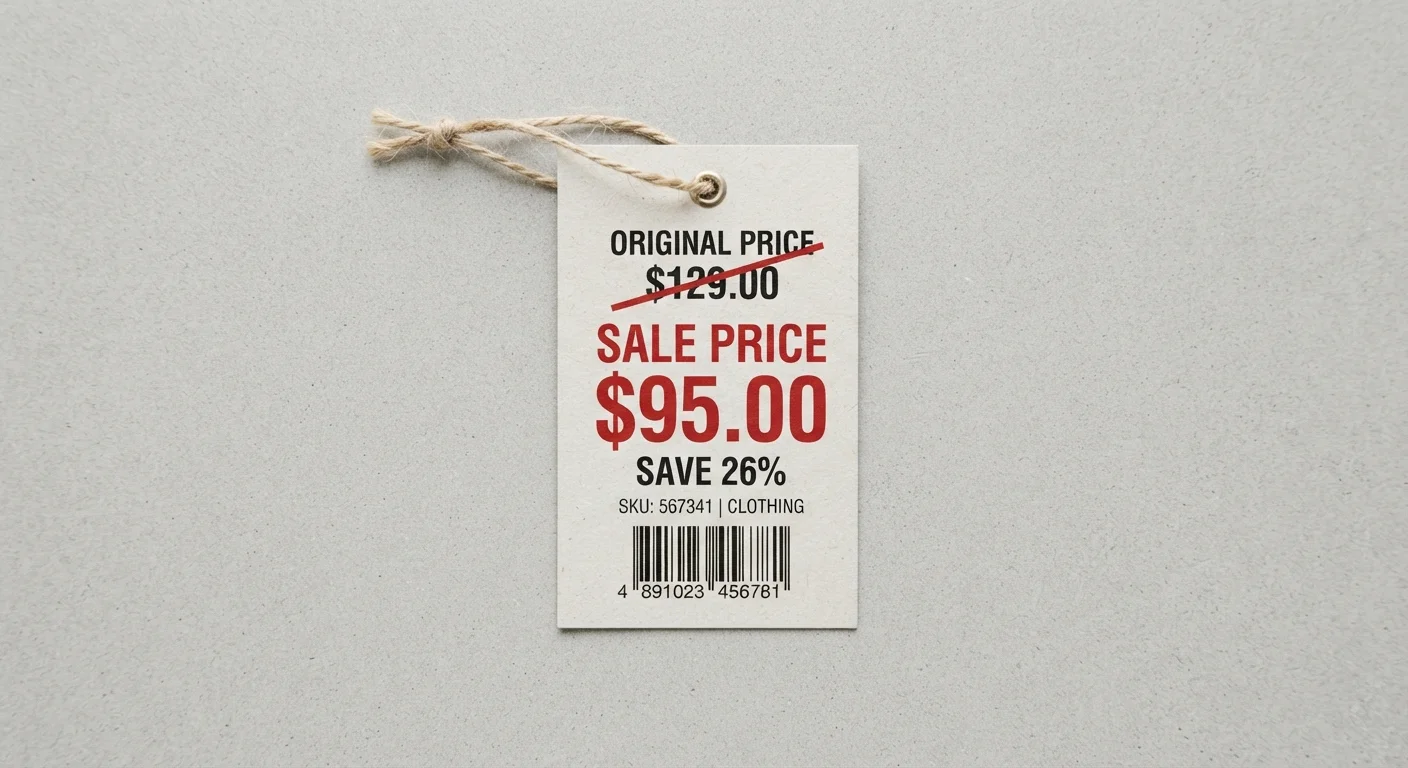
Photo: AskSpecialist.net editorial
Key Takeaways
- Reference prices shown next to sale prices are sometimes set artificially high and may not reflect real market transactions.
- The anchoring effect is a documented cognitive bias, not a character flaw - it influences virtually everyone.
- Comparing the sale price to an independent market price, not the retailer's listed original, reveals whether a deal is genuine.
- Price history tools can confirm whether an item has actually sold at the 'original' price before.
- Slowing down before purchase - rather than reacting to the discount size - is the most effective counter-strategy.
How Anchoring Actually Works in Retail
When you see a jacket marked $299 with a line through it and $149 in bold below, your brain does something automatic: it treats $299 as the benchmark for value. The $150 gap feels like money gained, not money spent. That's anchoring - and it operates before you've consciously evaluated whether the jacket is worth $149 at all.
Behavioral economists have documented this pattern extensively. The first number encountered in a numerical judgment anchors subsequent estimates, pulling them toward the starting point even when that number is arbitrary. In retail, this is engineered deliberately. A retailer doesn't need customers to believe the original price was fair - only that the gap between the two numbers represents savings.
Crucially, the anchor doesn't have to be accurate to be effective. A price that was technically offered for one day - or only in limited markets - can still legally appear as a crossed-out reference in many contexts, depending on how the retailer structures the claim.
“The first piece of information we receive about a price becomes the standard against which all subsequent prices are measured - even when that first number was never meaningful.”
— Dan Ariely, Behavioral economist and author of 'Predictably Irrational'
Where 'Original Prices' Come From
Not every posted original price is a fiction. Some reflect genuine markdowns from prices a retailer actually charged. But the category is wide:
- Manufacturer's Suggested Retail Price (MSRP): A number manufacturers publish, rarely the actual transaction price in competitive markets. Using MSRP as an anchor can make any price look like a bargain.
- Briefly offered prices: An item listed at full price for a few days before a prolonged 'sale' creates a technically defensible original price that few consumers ever paid.
- Inflated launch prices: Some products are introduced at a high price specifically to establish an anchor, with a markdown planned from the outset.
Understanding how these reference prices are constructed is foundational. How retailers calculate markdowns reveals that the percentage discount is only as meaningful as the baseline it's calculated from.
~60%
Consumers influenced by reference prices
Research in consumer behavior consistently finds that a majority of shoppers rate a product as a better value when a higher reference price is shown alongside the current price, even when the reference price is arbitrary.
3-5 days
Minimum prior-sale period in some FTC guidance
FTC guidelines on reference pricing suggest a former price should have been offered in good faith for a reasonably substantial period - a threshold some retailers interpret narrowly.
Practical Habits That Neutralize Anchoring
Awareness of anchoring helps, but awareness alone rarely overrides the bias in the moment. These concrete habits reduce its influence:
- Ignore the strikethrough price. Mentally block it out and ask only: is this item worth the current price to me, independent of what it was supposedly listed at?
- Research comparable prices independently. A quick search across multiple sellers shows whether the sale price is genuinely competitive or merely below an inflated anchor.
- Check price history before big purchases. Tools that log historical prices can confirm whether an item has ever actually sold at the stated original price - a check that frequently reveals anchors that were never real transaction prices.
- Set a personal ceiling before browsing. Deciding in advance what you're willing to pay removes the anchor's power to redefine 'reasonable.'
These habits matter because anchoring is one of several shopping behaviors that quietly erode budgets even when consumers believe they're being careful.
Use Price History Before Big Purchases
When the Reference Price Is Legitimate
Not every discount deserves suspicion. Clearance pricing on end-of-season inventory, genuine markdowns on overstocked items, and price reductions following a supplier price cut can all represent real savings from prices customers actually paid. The goal isn't cynicism - it's informed evaluation.
The practical test: does independent price data corroborate the original price? If a price history log shows the item sold at or near the stated original for an extended period, the markdown is more credible. If the 'original' price appears only as a header above the current price with no supporting transaction history, treat it as a marketing anchor rather than a factual baseline.
Retail pricing is not inherently deceptive, but the mechanics of anchoring mean that even honest retailers benefit from displaying reference prices prominently. Knowing that, you can engage with sale pricing on your own terms - evaluating the actual price against your actual needs, not against a number designed to make the sale look irresistible.
Frequently Asked Questions
The content on this site is provided for informational purposes only and should not be considered a substitute for professional advice. While we strive to provide accurate and up-to-date information, we make no guarantees regarding its completeness or accuracy. Always consult a qualified professional for advice specific to your circumstances before making any decisions.