
Keeping Your Devices Safe and Charged While Traveling Internationally

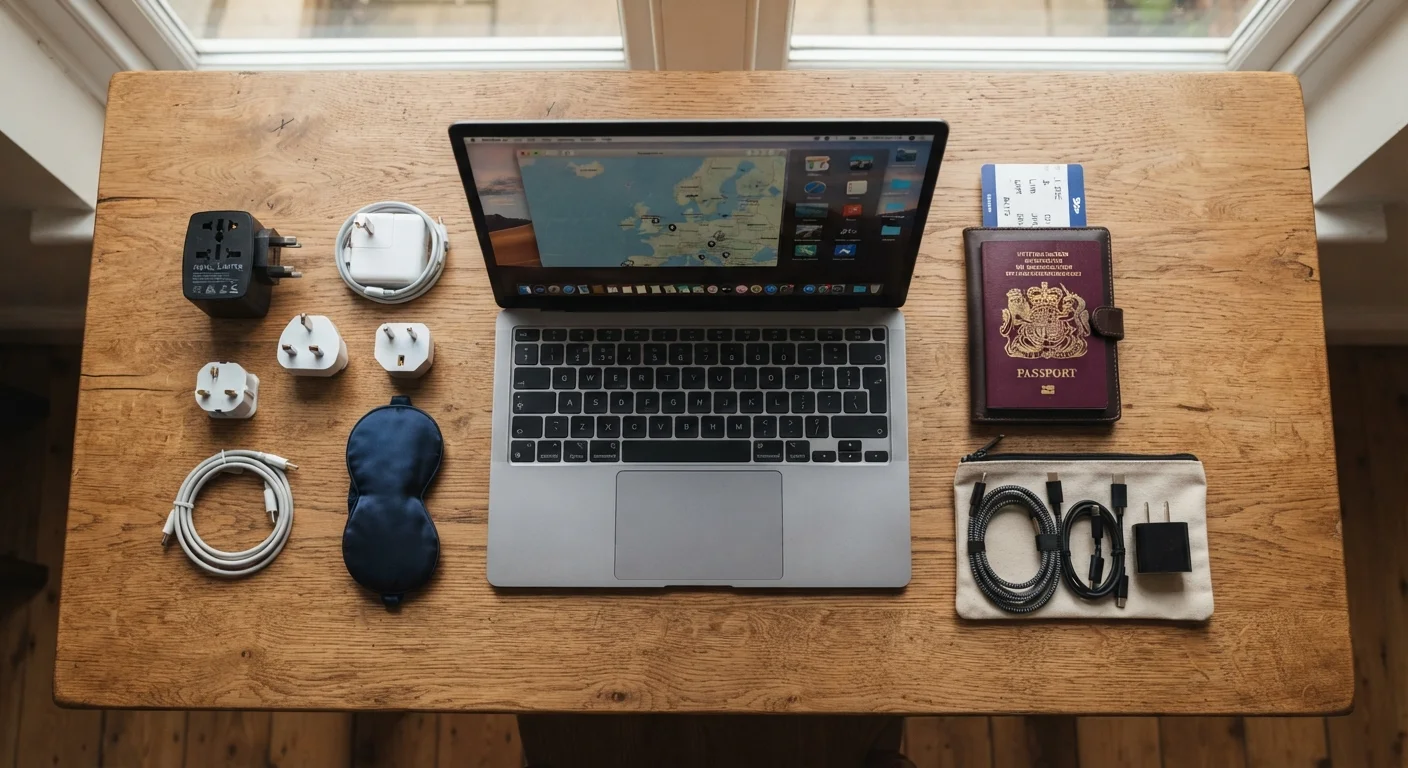
Photo: AskSpecialist.net editorial
Understanding Voltage and Plug Standards Worldwide
The United States runs on 110-120 volts at 60 Hz. Most of Europe, Asia, Africa, and South America operate on 220-240 volts at 50 Hz. Plugging a device designed for 110V into a 220V outlet without the right equipment can permanently damage it - or create a fire hazard.
Before packing any electronics, check the small print on the device's power adapter or charger. If it reads something like "Input: 100-240V, 50/60Hz," your device is dual-voltage and only needs a plug adapter - not a voltage converter. Most modern laptops, phone chargers, and camera chargers are dual-voltage. Hair dryers, flat irons, and older electronics frequently are not.
Plug adapters come in several regional types. Type C (two round pins) covers most of Europe. Type G (three rectangular pins) is standard in the UK, Ireland, and much of East Africa. Type I (two or three flat angled pins) is used in Australia and Argentina. Carrying a universal multi-plug adapter simplifies packing, but verify it's compatible with your specific destinations before you leave. See our travel budget guide to factor adapter and converter costs into your pre-trip expenses.
Protecting Your Devices and Data on Public Networks
Free Wi-Fi at airports, hotels, and cafes is convenient - and genuinely risky. Open networks can expose your login credentials, banking information, and personal files to other users on the same connection. This is not hypothetical: security researchers regularly demonstrate how easily data can be intercepted on unsecured public networks.
Voltage Converter
A device that changes the electrical voltage from one level to another. Required when a device is not dual-voltage and must be used in a country with a different voltage standard than its design.
Plug Adapter
A physical connector that allows a plug from one country to fit into an outlet in another. It does not change voltage - only the plug shape.
Dual-Voltage Device
Electronics that accept both 110-120V and 220-240V input, making them safe to use internationally with only a plug adapter. Look for this specification on the power brick or charger label.
VPN (Virtual Private Network)
Software that encrypts your internet connection and routes it through a secure server, helping protect your data from interception on public or unsecured networks.
Power Bank
A portable rechargeable battery pack used to charge devices when wall outlets are unavailable. Capacity is measured in milliampere-hours (mAh).
Practical steps to reduce exposure:
- Use a VPN (Virtual Private Network): A VPN encrypts your internet traffic, making it much harder for third parties to intercept. Set one up before you leave home, since some countries restrict VPN services or make them harder to download once you're there.
- Avoid accessing financial accounts on public Wi-Fi unless you are connected through a VPN or your phone's cellular data.
- Turn off auto-connect: Disable the setting that automatically joins open Wi-Fi networks. Some rogue hotspots mimic legitimate hotel or airport network names.
- Keep devices updated: Security patches close known vulnerabilities. Update your operating system and apps before departure.
Physical security matters too. Use a privacy screen on your laptop in crowded spaces, keep devices in your personal bag rather than checked luggage, and consider a TSA-approved cable lock for shared hostel environments. For guidance on what to keep with you through security, see our article on carry-on packing mistakes.
Keeping Devices Charged on Long Journeys
Power access varies widely by destination, transit mode, and accommodation type. Budget travelers staying in older properties in developing countries may encounter limited or unreliable outlets. Long-haul flights, trains, and buses frequently have insufficient charging ports relative to passenger demand.
A portable power bank is one of the most consistently useful travel accessories you can carry. Look for capacity in the 10,000-20,000 mAh range, which is typically enough for two to four full smartphone charges. Confirm that airline carry-on rules permit your power bank's capacity - most airlines follow guidelines set by aviation safety authorities that cap lithium batteries at a specific watt-hour limit. Check the airline's current policy before flying.
Other practical habits:
- Charge all devices fully the night before a travel day - don't rely on airport access.
- Carry a multi-port USB charger so one outlet powers multiple devices simultaneously.
- Enable low-power or battery-saver mode during transit to extend charge life.
- Download offline maps, itineraries, and translation content before leaving Wi-Fi access.
These logistics fit naturally into broader trip preparation. Our trip planning hub covers the full range of practical pre-departure steps for international travel.
The content on this site is provided for informational purposes only and should not be considered a substitute for professional advice. While we strive to provide accurate and up-to-date information, we make no guarantees regarding its completeness or accuracy. Always consult a qualified professional for advice specific to your circumstances before making any decisions.