
Fixed-Rate vs. Adjustable-Rate Mortgages

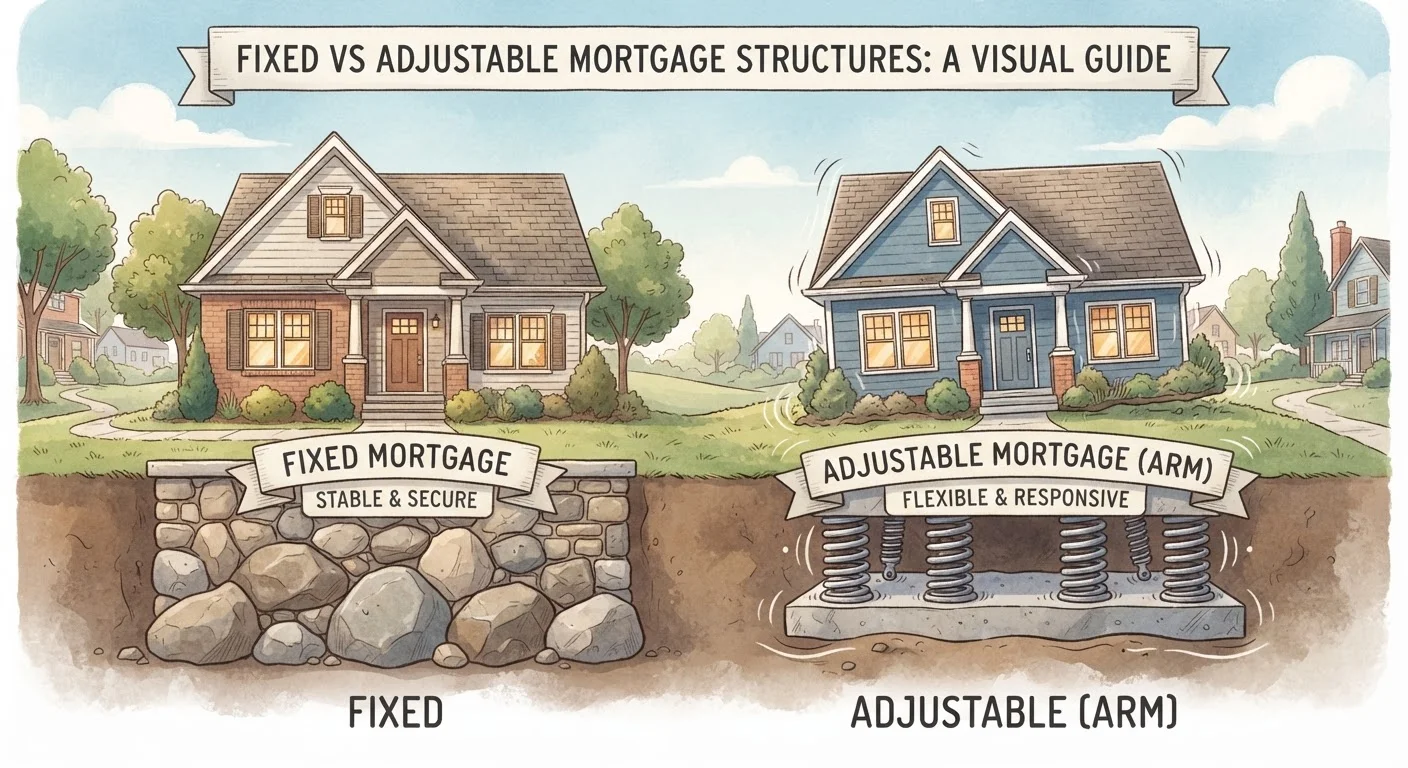
Photo: AskSpecialist.net editorial
Key Takeaways
- A fixed-rate mortgage keeps your interest rate unchanged for the entire loan term, ensuring payment stability.
- An adjustable-rate mortgage (ARM) starts with a fixed period, then resets periodically based on a market index.
- ARMs typically offer lower initial rates than fixed-rate loans, but carry the risk of future rate increases.
- Your time horizon in the home is one of the most important factors in choosing between the two.
- Rate caps on ARMs limit how much your rate can increase per adjustment and over the loan's lifetime.
How Each Mortgage Type Works
A fixed-rate mortgage carries an interest rate that never changes. Whether your loan term is 15 or 30 years, the rate set at closing is the rate you pay until the loan is paid off or refinanced. Your principal and interest payment stays the same every month, though your total housing cost can still shift if property taxes or homeowner's insurance premiums change.
An adjustable-rate mortgage (ARM) works in two phases. The first is a fixed-rate introductory period - commonly 5, 7, or 10 years - during which your rate is locked and typically lower than prevailing fixed-rate options. After that period, the rate adjusts at defined intervals (usually annually) based on a benchmark index, such as the Secured Overnight Financing Rate (SOFR), plus a set margin determined by your lender.
ARMs are described using shorthand like "5/1" or "7/6" - the first number is the length of the fixed period in years, and the second is how often the rate adjusts afterward (1 means annually, 6 means every six months). Understanding this notation helps you compare products accurately.
| Criterion | Fixed-Rate Mortgage | Adjustable-Rate Mortgage (ARM) |
|---|---|---|
| Interest Rate | Locked for entire loan term | Fixed initially, then adjusts periodically |
| Initial Rate | Typically higher | Typically lower |
| Monthly Payment Stability | Fully predictable (P&I) | Predictable during fixed period, variable after |
| Best Loan Term | 15 or 30 years | 5/1, 7/1, 10/1 ARM structures common |
| Rate Increase Risk | None | Yes, subject to cap limits |
| Ideal Time Horizon | 7+ years in the home | Under 7 years in the home |
| Complexity | Simple and straightforward | Requires understanding of index, margin, caps |
Rate Caps, Risk, and What Changes Over Time
One of the most important protections built into ARMs is the rate cap structure. Federal regulations require lenders to disclose three cap figures: an initial adjustment cap (the maximum increase at the first reset), a periodic cap (the maximum increase at each subsequent adjustment), and a lifetime cap (the total maximum increase over the loan's life). A common cap structure is 2/2/5 - meaning the rate can rise no more than 2% at first reset, 2% at each annual reset, and 5% total over the loan's life.
Even with caps, a significant rate increase can substantially raise your monthly payment - a phenomenon sometimes called payment shock. Borrowers should stress-test their budget against the maximum possible rate before committing to an ARM. For context, interest rates and home prices interact in complex ways, so timing the market is rarely as simple as it appears.
~90%
Share of mortgages that are fixed-rate
According to Freddie Mac data, the vast majority of U.S. mortgage borrowers have historically chosen fixed-rate products, particularly during periods of low rates.
2/2/5
Common ARM rate cap structure
This widely used cap means an ARM's rate can increase at most 2% at first reset, 2% per subsequent adjustment, and 5% over the loan's lifetime.
2%-5%
Typical refinancing cost as share of loan
The Consumer Financial Protection Bureau (CFPB) notes that refinancing generally costs between 2% and 5% of the loan principal in closing costs.
Fixed-rate mortgages carry none of this adjustment risk, but they do come with a trade-off: if prevailing rates drop significantly after you close, you'll need to refinance - incurring closing costs - to capture a lower rate. Refinancing typically costs 2%-5% of the loan amount, so the math only works if you plan to stay in the home long enough to recoup those costs.
Choosing the Right Structure for Your Situation
The decision between a fixed and adjustable rate is fundamentally about time horizon and risk tolerance. If you're buying a starter home with plans to upsize in five years, an ARM's lower initial rate can reduce interest costs during that window. If you're buying the home where you plan to raise a family for the next two decades, the certainty of a fixed rate is worth the premium you pay for it.
Financial circumstances matter too. If your income is variable or your budget is stretched, the stability of a fixed payment provides a meaningful safety net. First-time buyers navigating the home purchase process for the first time should also factor in the broader picture - our look at down payment myths explains how your upfront cash decisions interact with the financing you qualify for.
It's also worth noting that ARM rates are not always lower than fixed rates - in certain market environments, the gap narrows to the point where the added complexity of an ARM offers little benefit. Always compare the actual annual percentage rates (APRs) on both loan types from multiple lenders before deciding. For readers still weighing homeownership itself, renting vs. buying a home covers the broader financial and lifestyle considerations that come before mortgage selection.
This article is for general informational purposes only and does not constitute financial or mortgage advice. Consult a licensed mortgage professional for guidance specific to your financial situation.
The content on this site is provided for informational purposes only and should not be considered a substitute for professional advice. While we strive to provide accurate and up-to-date information, we make no guarantees regarding its completeness or accuracy. Always consult a qualified professional for advice specific to your circumstances before making any decisions.