
Traveling with Medications: Documentation, Storage, and Border Crossings

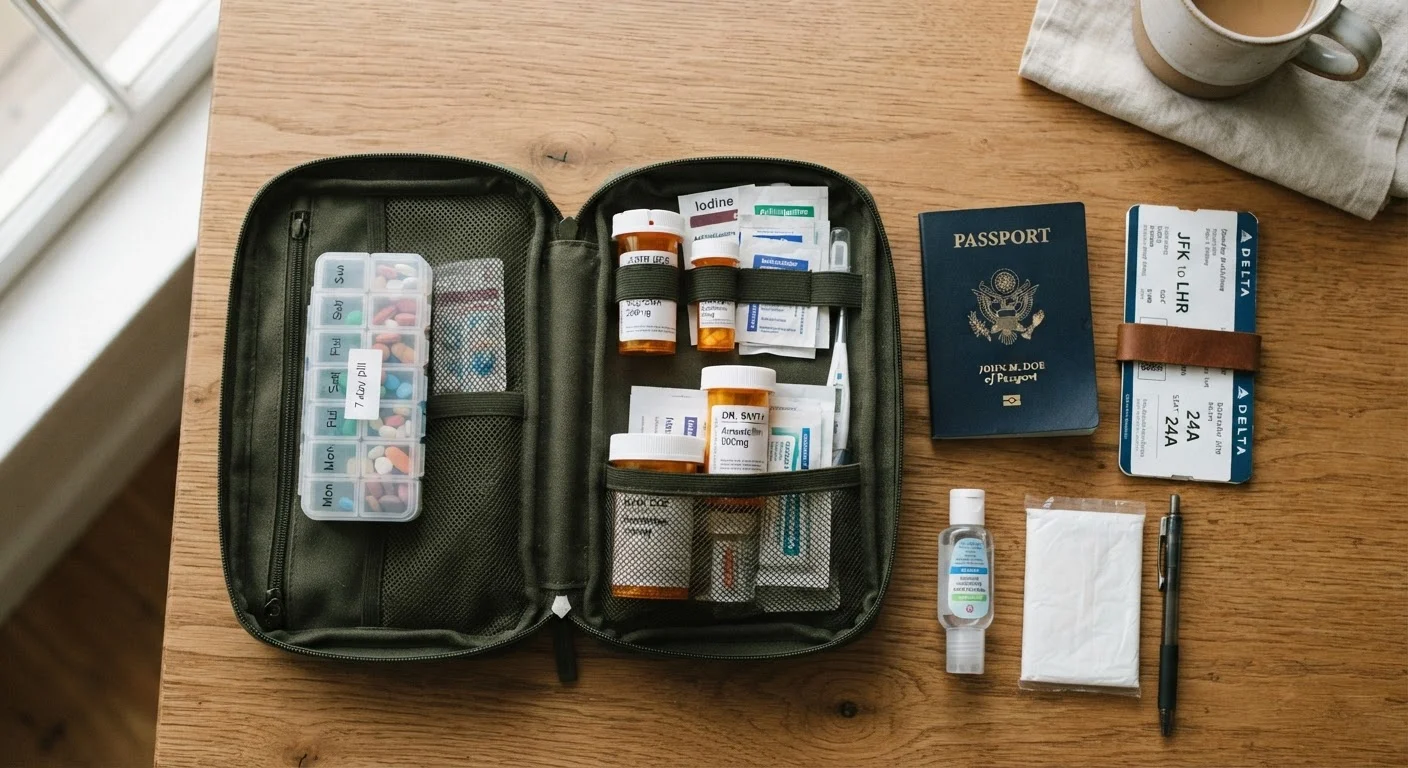
Photo: AskSpecialist.net editorial
Key Takeaways
- Always carry medications in their original, labeled pharmacy containers when crossing borders.
- A signed letter from your prescribing physician is essential for controlled substances and injectable medications.
- Verify destination country rules for your specific medications before departure - regulations vary widely.
- Temperature-sensitive medications require insulated cases and careful advance planning.
- Keep all medications in your carry-on bag to avoid loss or temperature damage from checked luggage.
Why Medication Planning Deserves Its Own Checklist
For most travelers, medications are an afterthought - something tossed into a bag the night before departure. That approach creates real problems at border crossings and security checkpoints, especially when carrying prescription drugs, controlled substances, or syringes. A small amount of preparation, ideally two to four weeks before your trip, can prevent delays, confiscation, or worse.
This guide walks through the documentation you need, how to pack and store medications correctly, and what to expect at international borders. It's part of the broader trip-planning groundwork covered in our pre-departure checklist - a solid reference to work through alongside this article.
This article provides general travel information only and is not medical or legal advice. Always consult your healthcare provider and verify requirements with official government and embassy sources before traveling.
What you will need
Documentation: What to Gather Before You Leave
Documentation is your first line of defense at any border. Here's what to have in hand:
- Original pharmacy labels: Every prescription container should display your name, the prescribing physician's name, the medication name, dosage, and dispensing pharmacy. Do not transfer pills into unmarked travel containers for international trips.
- Physician's letter: For controlled substances (such as opioids, benzodiazepines, or stimulants), injectables, or large quantities of any medication, request a signed letter from your doctor on official letterhead. It should state your diagnosis in general terms, the medication name and dosage, and that the medication is medically necessary.
- Translation of documentation: If traveling to a country where English is not widely used in official contexts, consider having your physician's letter translated into the local language by a certified translator.
- Copies stored separately: Keep digital copies of all documentation in a secure cloud storage account so you can access them if originals are lost.
For narcotics and certain psychotropic substances, some countries require an import permit obtained in advance through the destination country's health ministry. The U.S. Embassy or Consulate website for your destination is a reliable starting point, as is the destination country's official government health authority.
Some Common U.S. Medications Are Banned Abroad
Packing and Storage: Protecting Your Medications in Transit
How you pack medications matters as much as what you carry. The core rule: all medications travel in your carry-on bag, not checked luggage. Checked bags can be lost, delayed, or exposed to extreme temperatures in cargo holds - none of which you can control.
Ask Your Pharmacist for a Travel Supply Early
For temperature-sensitive medications such as insulin, certain biologics, or eye drops, invest in a quality insulated travel case with a reusable cooling element. These keep medications within safe temperature ranges for 24 to 48 hours depending on the product. On longer trips, research how to resupply cooling elements or refrigeration at your destination before you leave.
Liquids, gels, and aerosols - including liquid medications - follow TSA's standard rules for carry-ons in the U.S. However, medically necessary liquids in quantities exceeding the standard 3.4-ounce limit are permitted with proper labeling; declare them separately at the security checkpoint. Our guide on carry-on packing mistakes covers additional security checkpoint considerations worth reviewing.
For needles and syringes, TSA allows them when accompanied by the injectable medication and its label. Carry a sharps disposal container if your trip is extended, as many countries and airlines have specific disposal rules.
Navigating Border Crossings with Medications
International border rules for medications are not uniform. A medication that is legal and readily available in the United States may be a controlled substance - or outright prohibited - in another country. This is not a minor issue; travelers have faced confiscation, fines, or detention for carrying medications that were perfectly legal at home.
Steps to take before any international trip:
- Identify every prescription and over-the-counter medication you plan to carry, including vitamins and supplements.
- Check the destination country's official health ministry or embassy resources for restrictions. The U.S. State Department's country-specific information pages and the International Narcotics Control Board (INCB) publish guidance on controlled substances by country.
- If your medication requires an import permit, begin that process at least four to six weeks before departure - some permits take time to process.
- Carry only what you need for the trip duration, plus a reasonable buffer (typically a few extra days' supply in case of delays). Carrying unusually large quantities can raise flags regardless of documentation.
For travelers managing complex medication needs as part of broader international trip logistics, the international trip planning framework provides helpful context for sequencing all your pre-departure tasks.
Transit Countries Count Too
The content on this site is provided for informational purposes only and should not be considered a substitute for professional advice. While we strive to provide accurate and up-to-date information, we make no guarantees regarding its completeness or accuracy. Always consult a qualified professional for advice specific to your circumstances before making any decisions.