
Planning a Trip Alone vs. With a Group: How the Process Changes

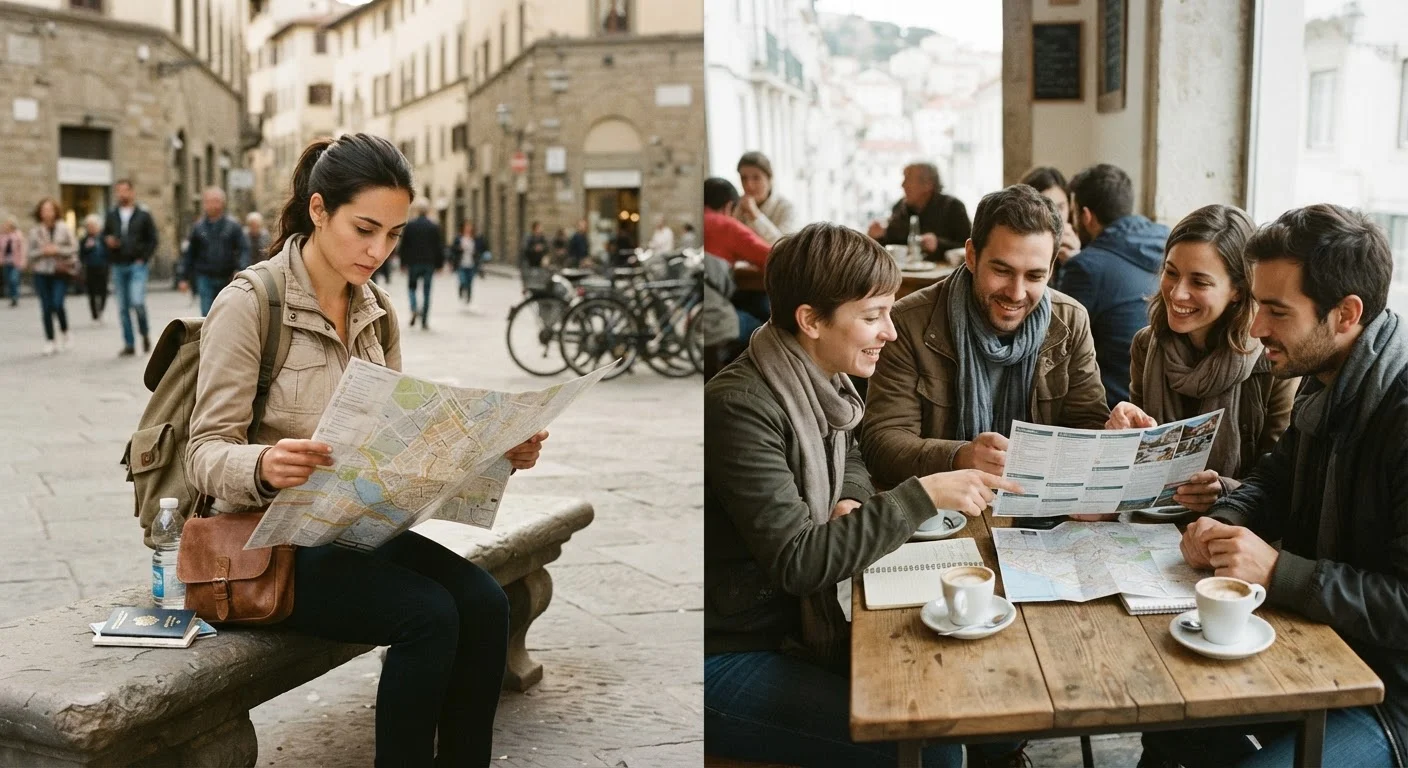
Photo: AskSpecialist.net editorial
Key Takeaways
- Solo planning is faster to execute but demands stronger personal safety and logistics awareness.
- Group planning introduces coordination overhead that grows significantly with each additional person.
- Budget decisions are simpler alone; group travel unlocks cost-sharing but also creates financial friction.
- Itinerary structure must be tighter for groups to prevent decision fatigue and conflict on the ground.
- Both formats benefit from understanding which decisions must be locked in early versus left flexible.
Where the Planning Process Actually Diverges
At first glance, planning a trip looks the same regardless of who's going: pick a destination, sort out transportation, book accommodation. But the underlying process - how decisions get made, how much buffer you need, how detailed your itinerary should be - changes substantially based on whether you're traveling alone or with others.
Solo planning is primarily a research and logistics exercise. You set the parameters, you decide the trade-offs, and you live with the results. Group planning adds a negotiation layer that can consume as much time as the logistics themselves. Understanding which model you're working in from the start helps you plan smarter rather than harder.
A well-structured itinerary looks different in each context - solo plans can afford more open blocks, while group itineraries generally need firmer scaffolding to keep everyone moving.
| Criterion | Solo Travel Planning | Group Travel Planning |
|---|---|---|
| Decision authority | Entirely your own | Requires group consensus |
| Itinerary flexibility | High - can pivot anytime | Lower - changes affect everyone |
| Budget management | Simple, personal | Complex, requires upfront alignment |
| Booking lead time needed | Moderate | Longer - more moving parts |
| Pace control | Fully self-directed | Must accommodate all members |
| Safety research burden | Higher - no backup on the ground | Shared awareness across group |
| Cost-sharing potential | None | Significant - rooms, transport, tours |
| Coordination overhead | Minimal | High, scales with group size |
Decision-Making, Budget, and Logistics
Solo travelers make every call unilaterally - which is both a freedom and a responsibility. There's no one to catch an overlooked detail or flag a bad accommodation review. That independence demands a more disciplined personal research process, particularly around safety and navigation. For practical guidance on staying oriented on your own, see solo travel in unfamiliar cities.
Budget management is cleaner when you're alone: your spending choices affect only you. Group budgets require upfront alignment. Mismatched expectations around dining, accommodation tier, or activity spend are among the most common sources of group travel friction - and they're almost always avoidable with one honest pre-trip conversation.
3-5x
Longer pre-trip communication for groups
Travel planners and group tour operators commonly note that coordinating schedules and preferences for groups of four or more can multiply pre-trip communication by several times compared to solo or pair travel.
~30%
Per-person savings on shared accommodation
Splitting the cost of a multi-bedroom vacation rental or suite among four to six travelers frequently reduces per-person lodging costs substantially compared to individual hotel bookings in the same market.
Logistics scale non-linearly with group size. Booking for two is roughly twice the work of booking for one, but booking for eight is far more than four times the complexity. Transportation, dining reservations, and room configurations all require more lead time and more confirmations. Groups also need contingency plans for the scenarios solo travelers simply sidestep - what happens if one person gets sick, misses a connection, or drops out before departure.
Pace is another practical pressure point. Solo travelers can push hard one day and recover the next without impacting anyone. Groups need a pace the slowest member can sustain, which often means building in more buffer time than any individual traveler would choose. Pace and buffer planning consistently surface as underrated drivers of whether a trip feels restorative or exhausting - for groups, getting this wrong affects everyone simultaneously.
For destination-specific planning where these dynamics become especially pronounced - like navigating a high-logistics destination with a group - see what makes Alaska different from other US destinations.
The content on this site is provided for informational purposes only and should not be considered a substitute for professional advice. While we strive to provide accurate and up-to-date information, we make no guarantees regarding its completeness or accuracy. Always consult a qualified professional for advice specific to your circumstances before making any decisions.