
Reading a Window Sticker: What Every Line on a Monroney Label Means

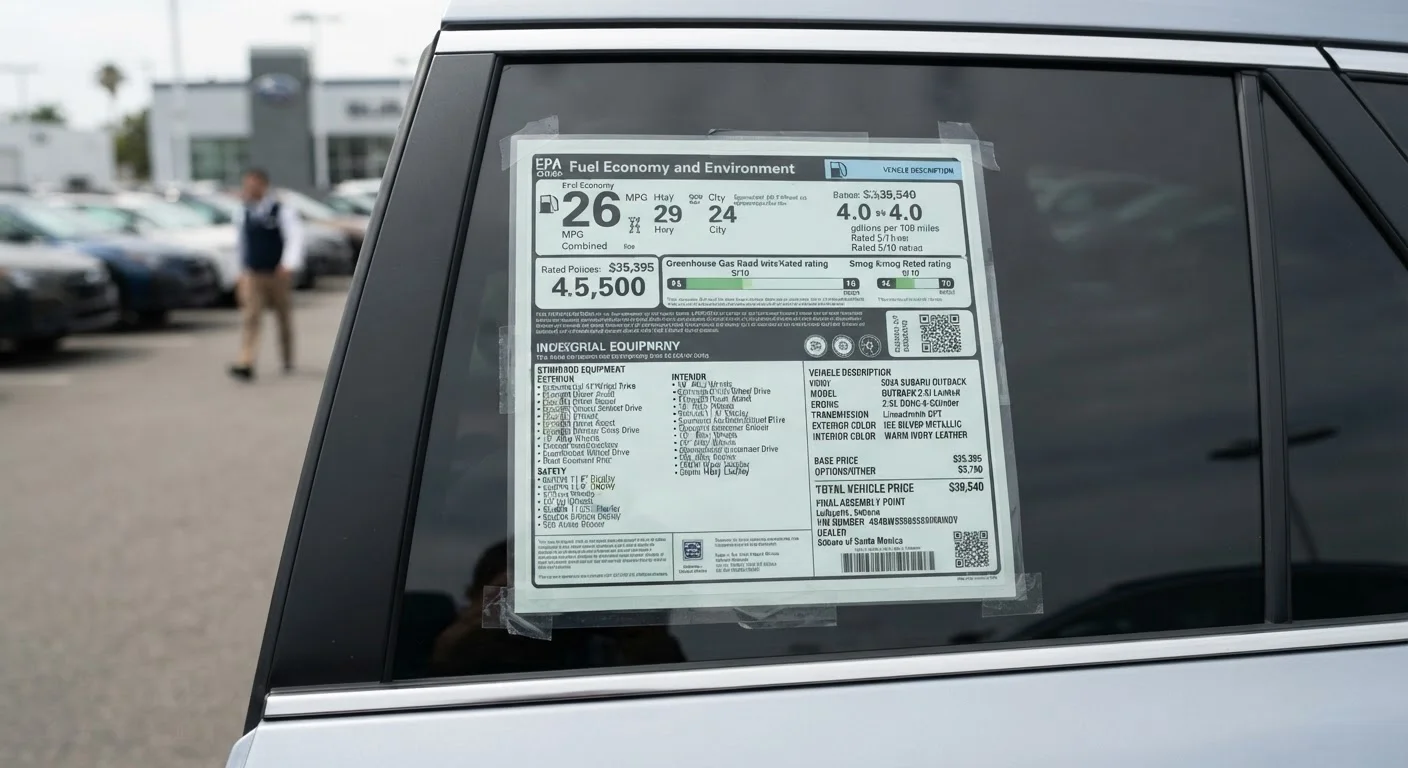
Photo: AskSpecialist.net editorial
What Is a Monroney Label?
That large sticker glued to a new car's window isn't a suggestion - it's a federal requirement. The Monroney label (named after the senator who sponsored the legislation in 1958) must be affixed to every new passenger vehicle sold in the United States. The dealer cannot legally remove it before the sale; only the buyer can.
The label is standardized, meaning every automaker must organize information in the same general format. Once you know how to read one, you can read any of them. Think of it as a vehicle's nutrition label - a structured summary of what you're actually getting. Just as consumers learn to read a nutrition label to understand what's inside packaged food, learning the Monroney puts you firmly in control at the dealership.
| Law requiring the label | Automobile Information Disclosure Act (1958) |
| Who can remove it | Only the vehicle purchaser - not the dealer |
| Fuel economy ratings source | U.S. Environmental Protection Agency (EPA) |
| Crash-test ratings source on label | NHTSA (National Highway Traffic Safety Administration) |
| Components of total sticker price | Base MSRP + options + destination charge |
Breaking Down Each Section
Vehicle Identification and Base Price
The top of the sticker identifies the make, model, model year, trim level, and the manufacturing plant where the car was built. Below that is the Manufacturer's Suggested Retail Price (MSRP) - the automaker's recommended price for the base vehicle. "Suggested" is the key word: dealers can charge more or less, and the MSRP is your starting point for negotiation, not a fixed price. For more on what MSRP actually means in a retail context, see our explainer on retail pricing language.
Standard Equipment
This section lists every feature included in the trim level you're looking at - think engine size, transmission type, standard safety tech, and infotainment features. Read it carefully; dealers sometimes verbally describe add-ons as "standard" when they're actually paid upgrades.
Optional Packages and Add-Ons
Each optional package or individual option is listed with its own line-item price. These are features the specific vehicle on the lot has been outfitted with - things like a sunroof package, upgraded audio, or a towing hitch. These costs are added to the base MSRP to produce the total vehicle price shown at the bottom of this section.
Destination and Delivery Charge
This is a flat fee set by the manufacturer - not the dealer - to cover shipping the vehicle from the factory to the dealership. It's non-negotiable and the same for every buyer of that model, but it is part of the total sticker price.
Total MSRP
The bottom-line sticker price: base MSRP + options + destination charge. This is not the out-the-door price (which adds taxes, registration fees, and dealer fees), but it's the clearest apples-to-apples comparison point when shopping multiple vehicles.
Fuel Economy and Environmental Data
The middle section of most Monroney labels is dominated by the EPA fuel economy estimates - city mpg, highway mpg, and a combined figure. These numbers are generated through standardized EPA testing, not real-world driving. Your actual mileage will vary based on driving habits, terrain, and load.
MSRP
Manufacturer's Suggested Retail Price - the price the automaker recommends the dealer charge. It is a starting point, not a fixed or legally binding price.
MPGe
Miles per gallon equivalent - a metric used for electric and plug-in hybrid vehicles that converts energy consumption into a figure comparable to gasoline mileage.
Destination charge
A flat, manufacturer-set fee covering transportation of the vehicle from the factory to the dealership. It is the same for every buyer of that model and is non-negotiable.
Trim level
A specific configuration or tier of a vehicle model that defines which features and equipment are included as standard. Higher trims generally include more technology and comfort features.
EPA estimate
Fuel economy figures produced by standardized U.S. Environmental Protection Agency tests. Real-world results vary based on driver behavior, conditions, and vehicle load.
The label also displays an annual fuel cost estimate, calculated using average fuel prices and assumed annual mileage. Use it as a relative comparison tool between vehicles, not as a budget guarantee. Alongside that, you'll find a fuel economy rating bar showing where this vehicle lands compared to similar vehicles in its class - a quick visual benchmark.
For electric and hybrid vehicles, energy consumption is expressed in MPGe (miles per gallon equivalent) or kWh per 100 miles, plus an estimated driving range on a full charge or tank.
Greenhouse Gas and Smog Ratings
Two bar-chart scales rate the vehicle from 1 to 10 - one for greenhouse gas emissions, one for smog-forming pollutants. Higher scores mean cleaner. These scales compare the vehicle against all vehicles, not just its segment.
Safety Ratings and What They Actually Indicate
Some Monroney labels include government crash-test ratings from the National Highway Traffic Safety Administration (NHTSA), displayed as a star scale from 1 to 5. Categories typically include overall vehicle score, frontal crash, side crash, and rollover resistance.
Not every new vehicle will have ratings populated at the time of sale - testing takes time, and some vehicles reach dealerships before results are published. If the stars are blank, check the NHTSA website directly.
Note that NHTSA ratings are separate from Insurance Institute for Highway Safety (IIHS) ratings. Both are credible; they use different test protocols and rating scales. Neither set of ratings appears on the Monroney by default - IIHS results must be looked up independently.
Once you're past the purchase, staying informed about your vehicle's systems matters too. Our guide on dashboard warning lights is a useful next reference. And when you're ready to insure your new vehicle, understanding your coverage options is the logical next step.
1 to 5
NHTSA star safety rating scale
NHTSA rates vehicles across frontal, side, and rollover categories on a five-star scale; five stars represents the highest safety performance.
1 to 10
EPA emissions rating scale on Monroney
The EPA's greenhouse gas and smog ratings compare the vehicle against all light-duty vehicles, with 10 being the cleanest possible score.
The content on this site is provided for informational purposes only and should not be considered a substitute for professional advice. While we strive to provide accurate and up-to-date information, we make no guarantees regarding its completeness or accuracy. Always consult a qualified professional for advice specific to your circumstances before making any decisions.